By Jonathan Laws, ACA, Ch.FCSI, Senior Independent Financial Adviser, Cameron James USA.
Our clients fall into two groups. Some live in the US and have money, or a past, in the UK: a pension from earlier working life, an ISA left behind, or a move from the UK that has just happened or is about to. Others are US expats: US citizens and green card holders living outside the US, still filing US tax returns and still holding 401(k)s, IRAs and brokerage accounts back home.
Both groups tend to discover the same thing. Most advisers only understand one side of their life. A US adviser may not touch a UK pension, and may stop managing your accounts once you have an overseas address. An adviser outside the US may not be permitted to advise a US resident at all, and may not understand what US tax rules do to the funds they would normally recommend.
Our process is built for exactly that position. This page explains what happens at each stage of working with Cameron James USA, how we invest, how we explain our thinking, and how two tax systems, two sets of rules and two currencies are planned together rather than separately.
Your discovery meeting
Your discovery meeting is free and carries no obligation. This page explains what happens at each stage after it, and what to have ready beforehand.
Who This Process Is For
US residents with UK connections
- US citizens and green card holders with UK pensions or investments built up during time spent working or living in the UK.
- British expats who have settled in the US and still hold UK pensions, ISAs or investment accounts.
- UK expats moving to the US, or who have recently arrived. The time before your US residency starting date is often the most valuable planning window you will have.
US expats
- US citizens and green card holders living outside the US. You remain a US taxpayer wherever you live, so your 401(k)s, IRAs, brokerage accounts and any investments where you live all have to work under US rules.
- Americans planning a move abroad, or a return to the US. As with any move, the planning is most valuable before it happens.
Many of our clients sit in both groups at different points in their lives, which is exactly why one adviser who understands both sides matters.
The Framework Behind Our Process
We built our process on the financial planning process published by the Financial Planning Standards Board, the international standards-setting body for the financial planning profession. FPSB sets professional standards used across its global network, and owns the CERTIFIED FINANCIAL PLANNER marks outside the United States, where CFP Board sets and enforces them. The framework is collaborative and iterative: planner and client work through it together, and return to it as circumstances change (FPSB Financial Planning Practice Standards). In the United States, CFP Board sets out the same work as seven steps rather than six. The substance is the same.
The framework tells a planner what a good process looks like. It does not tell them how to invest, or how to plan for someone who is taxed as a US person on a UK pension. So we have added three things to it: our investment philosophy, our educational approach, and the cross-border work that sits underneath almost everything we do.
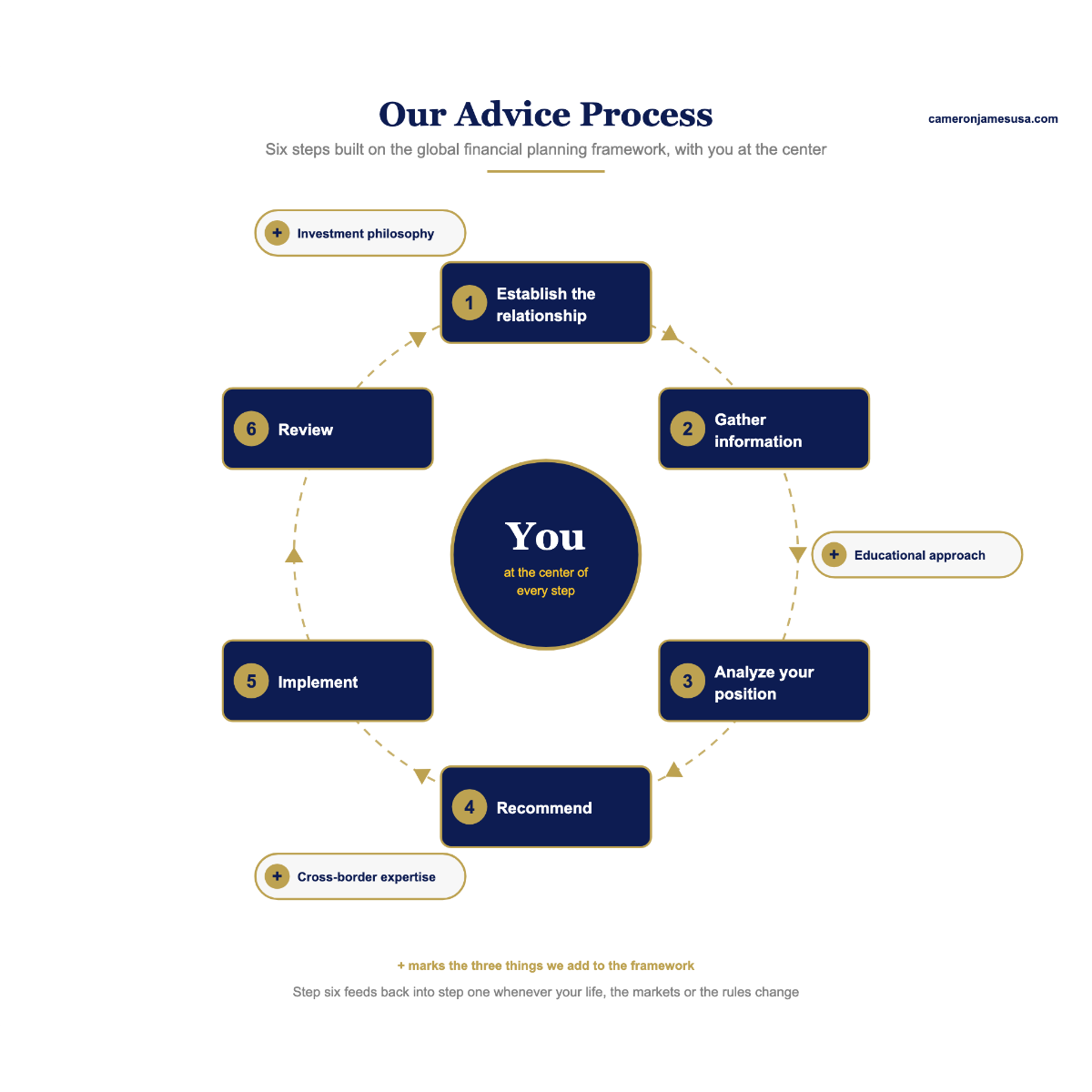
Our advice process. Six steps built on the FPSB framework, with you at the center and the three things we add shown underneath. Alt text: The Cameron James USA six-step cross-border financial advice process for US-connected clients.
The wheel is deliberate. Planning is not a straight line that ends when a product is in place. Step six feeds back into step one whenever your life, the markets or the rules change, and you sit at the center of every step.
| Step | What we do | What you do | The cross-border layer |
| 1. Establish the relationship | Explain our services, fees and limits, and agree the scope in writing | Tell us what prompted you to get in touch | Confirm on what basis we can advise you, wherever you live |
| 2. Gather information | Collect documents and understand your goals, values and experience | Share statements from both sides and talk openly about what matters | Citizenship, visa status, residence dates and future moves |
| 3. Analyze your position | Review holdings, charges and risk, and build a cash flow model | Check the assumptions with us | PFIC exposure, accounts restricted by a move, treaty position, state tax |
| 4. Recommend | Present a plain-English advice report with reasoning and alternatives | Ask questions, push back, take your time | Tax points flagged and routed to your CPA or enrolled agent |
| 5. Implement | Handle applications and chase providers until complete | Sign the paperwork | Providers that accept US persons, US custodians in your name |
| 6. Review | Two forward planning meetings a year | Tell us when life changes | Both tax years, continuing US filing, any change of country |
Table: the six steps, what each side does, and the cross-border layer that sits on top of each one.
Your Discovery Meeting: What to Have Ready
Web team: add anchor ID #discovery-meeting to this H2. The button in the box at the top of the page links to it.
Your discovery meeting is with a qualified adviser, over video, at a time that works for your time zone. It is a conversation rather than a sales meeting, and a little preparation makes it far more useful. If you can, have the following to hand.
- US accounts. Recent statements for your 401(k)s, IRAs, brokerage accounts and any employer equity.
- UK assets. Statements for UK pensions, including old workplace schemes, ISAs and investment accounts.
- Assets where you live. If you live outside the US, details of any pensions, accounts or property in your country of residence.
- Status and dates. Your citizenship, green card or visa status, the date you became or will become US resident, and any move you are planning.
- Your tax adviser. Your CPA or enrolled agent’s details, if you have one.
- Your questions. What prompted you to get in touch, and what you most want answered.
Do not worry if you cannot find everything. A rough picture is enough for the first conversation, and with your permission we can request the details from providers afterwards.
Step 1: Establishing the Relationship
Your first conversation, the discovery meeting, is with a qualified adviser, over video, at a time that works for your time zone. It costs nothing and commits you to nothing. The aim is to work out together whether we are the right firm for what you need.
Cameron James USA advisers hold individual SEC authorization, which is what allows us to advise US residents directly. It matters because many UK firms advising US residents rely on an exemption that does not allow them to market to, or hold themselves out to, people in the US. Asking any adviser how they are authorized to advise you is a reasonable first question.
For US expats, it means your US accounts can be advised on and managed by an adviser with SEC authorization after you leave the US. The rules of the country you live in matter too, and we check how they apply to you at the outset. If we cannot advise you where you live, we will tell you plainly.
We will also be clear about our boundaries from the start.
- We do not prepare tax returns or give tax advice. We plan around your tax position and work directly with your CPA or enrolled agent. If you do not have one who handles cross-border filing, we can introduce you.
- Defined benefit, or final salary, pensions with safeguarded benefits need a suitability opinion from a specialist Pension Transfer Specialist under UK rules. We explain how that works on our final salary pension page.
- We are fee-only by conviction and do not take commission, so we have no reason to favor one product over another.
Once both sides are comfortable, the scope of the work, the fees and how either party can end the arrangement are set out in writing. Nothing chargeable happens before you agree to it.
Step 2: Gathering Information
The numbers, on both sides
We need the whole picture. On the US side: 401(k)s and other workplace plans, IRAs both traditional and Roth, taxable brokerage accounts, employer equity and your Social Security record. On the UK side: pensions, whether workplace, personal or a SIPP, ISAs, investment accounts and your State Pension record. For US expats, any pensions, accounts or property in your country of residence. Plus cash in each currency, and debts. With your permission we contact providers directly for current values and scheme details, so you are not chasing paperwork across time zones.
You
Then the more important conversation. When do you want to stop working? Do you expect to stay where you are, return to the US or the UK, or retire somewhere else? Who depends on you, and where are they? How have past investment experiences shaped how you feel about risk? We assess both your attitude to risk and your capacity for loss, because they are not the same thing.
The US-UK layer
Your citizenship, green card or visa status, the date you became or will become US resident, and whether you might leave the US again all change the right answer. If you are a UK expat about to move to the US, tell us early. UK funds that were perfectly ordinary investments before the move can become PFICs from your residency starting date, and the window before that date is when the most options are open. The tax levers in that window belong with a CPA or enrolled agent, and we will make sure you speak to one in time.
If you are a US expat, the same problem runs the other way. Pension and investment products sold locally where you live are commonly PFICs, or otherwise awkward for a US taxpayer, and well-meaning local advice can create an expensive US tax problem.
Step 3: Analyzing Your Position
With the facts gathered, we assess how well your current arrangements support your goals, and where the gaps are.
- Cash flow modeling. A year-by-year projection of income, spending, assets and tax through your lifetime, stress tested against a wide range of market outcomes rather than one assumed growth rate.
- What your non-US holdings look like to the Internal Revenue Service. UK funds held outside a pension, and many funds bought locally by US expats, are commonly PFICs for a US taxpayer, with punitive tax and reporting consequences. Many UK platforms also freeze or close accounts once they learn a customer is US resident.
- Your US accounts when you live abroad. Many US brokers and plan providers restrict trading or close accounts once you have a non-US address. We look at where your US accounts can sit long term, and whether consolidating or rolling over makes sense.
- How your UK pension is treated. Under the US-UK tax treaty, a UK pension can receive favorable treatment, but the detail is complex and depends on the type of scheme and how benefits are taken. We map the issues and make sure your tax adviser sees them.
- State tax. Not every state follows the treaty, and some states may continue to treat you as resident after you move abroad. Where you live, or last lived, within the US can change the outcome.
- Overall risk and concentration. We look at everything as one portfolio. A 401(k) heavily weighted to US large companies changes what the rest of your money should hold.
If a goal is not realistic on current plans, we say so and talk through the options. Hearing it now is better than discovering it later.
Step 4: Developing and Presenting Our Recommendations
Our recommendations come in a written advice report that sets out what we recommend and why, the alternatives we considered and why we rejected them, the risks, and the assumptions everything rests on. It is written in plain English. If something in it needs a dictionary, we have written it badly.
Not every report recommends a change. If an arrangement is sound and suitable for a US-connected person, we will tell you to keep it. Where your recommendations raise tax questions, the report flags them clearly so they can be confirmed with your CPA or enrolled agent before you act.
There is no pressure to decide quickly. We expect questions and we expect to revise our recommendations as your feedback shapes them. The decision is yours, and our job is to make sure it is an informed one.
How We Invest: Owning the World
Where our recommendations include an investment portfolio, it is built on an evidence-based philosophy we describe as owning the world.
- Global equities are the engine of long-term growth. We spread portfolios across thousands of businesses worldwide rather than betting on one country, sector or company.
- We do not try to forecast markets. The evidence that active managers consistently beat the market after costs is poor. We use low-cost index funds weighted by the size of each market, and focus on what an adviser genuinely controls: cost and structure.
- Bonds provide balance and liquidity. Medium and short-term bonds buffer volatility and give a steadier pool to draw from when you need money, so equities do not have to be sold at a bad time.
- Risk is set pot by pot, through the plan. A client with an overall risk level of 6 out of 10 might hold a near-term income pot at 4 and a long-term pot at 10, because that combination best serves the plan.
- We account for what you hold elsewhere. Many of our clients have 401(k)s and IRAs heavily weighted toward US equities. Where that is the case, we tilt the portfolios we manage toward the rest of the world, so that across everything you own the balance is genuinely global.
- Versions reflecting environmental, social and governance considerations are available for clients who want them, built on the same principles.
For US-connected clients, fund selection also has to respect US tax rules. Where PFIC exposure matters, we build portfolios with funds chosen for your US reporting position, wherever you live, and we pay attention to the currency you will actually spend.
Step 5: Implementing the Plan
Once you decide to proceed, we agree priorities and responsibilities, and our administration team handles the applications and the due diligence the receiving provider and your existing scheme require.
- UK pensions are typically consolidated into an International SIPP with a provider that accepts US residents and works with advisers holding SEC authorization. Morningstar Wealth International is our preferred platform for US residents, and Novia Global is also used.
- US accounts stay with, or move to, a major US custodian such as Charles Schwab or Interactive Brokers that accepts clients living abroad, held in your own name and managed by your adviser. For US expats whose existing broker has restricted their account, this is often the fix.
For UK pension transfers, schemes are not always quick to respond. Our dedicated transfer team chases every scheme every few working days until the money has moved. When it arrives you receive a statement confirming the date and value received, your portfolio is invested as set out in your advice report, and your adviser books an onboarding call to walk you through your first valuation and hear your feedback.
Step 6: Reviewing, by Planning Forward
Ongoing clients have two forward planning meetings a year, around six months apart. We call them forward planning meetings rather than reviews because they look ahead: what is coming in the next six to twenty-four months, what needs deciding, and what should be in place before it arrives.
Two meetings is deliberate. Some clients have a lot of planning to work through in a year, and for others certain times of year are simply not a good time to meet. Offering two meetings a year gives a high chance that at least one is always held, whatever the year brings, and clients who want both will have two full planning meetings. Each meeting rebuilds your cash flow model, checks your portfolio and risk, and reviews contributions, withdrawals and the order to draw from each account. For US expats, each meeting also checks what your tax preparer will need for your continuing US filing and any change in your country of residence. Between meetings you can contact your adviser whenever something changes, at no extra cost. More detail is on our ongoing advice service page.
Our Educational Approach
Running through every step is one principle: you should understand your own plan well enough to explain it back to us. For US-connected clients that matters even more, because the rules are genuinely complicated and decisions made without understanding them tend to be expensive.
So we explain the reasoning behind every recommendation, not just the conclusion. We avoid jargon and explain the technical terms that cannot be avoided, from PFIC to treaty elections. We would rather spend extra time making sure something is understood than have you sign something you are unsure about. And we publish detailed guides on the questions US-connected clients ask us most, so you can read around a subject before or after we discuss it.
What the Process Costs
- First conversation: free and without obligation.
- No initial advice fee on US-connected investments or US pensions. Advice on your 401(k), IRAs and US investment accounts carries no initial fee.
- UK pension transfers: a published fixed fee plus a percentage, set out on our costs page.
- Ongoing advice: one ongoing advice fee covers the forward planning meetings, cash flow modeling, contact between meetings and the management of your investments.
- Platform and fund costs: separate, and disclosed in writing before you commit to anything.
We do not take commission. In our view, advice is clearer and fairer when the only person paying the adviser is the client.
Frequently Asked Questions
Can a UK financial adviser advise me if I live in the US?
Only if they are properly authorized to advise US residents. Cameron James USA advisers hold individual SEC authorization, which allows us to advise you directly on both your US and UK assets. Many UK firms rely on a narrow exemption that does not permit marketing to people in the US, so it is worth asking any adviser how they are authorized.
I am a US citizen living abroad. Can you manage my 401(k) and IRAs?
Yes. Our advisers hold individual SEC authorization, so your US accounts can be advised on and managed after you leave the US, held in your own name with a major US custodian that accepts clients living abroad. We also look at how any investments where you live fit with your US tax position, and check at the outset that we can advise you in your country of residence.
Is there really no initial fee?
There is no initial advice fee on US-connected investments or US pensions, and the discovery meeting is free. UK pension transfers carry a published fixed fee plus a percentage. Every fee is agreed in writing before any chargeable work starts.
What should I have ready for the discovery meeting?
Recent statements for your US accounts and UK assets, your residence and visa dates, and your CPA or enrolled agent’s details if you have one. There is a fuller list near the top of this page, but a rough picture is enough, and with your permission we can request the details from providers afterwards.
What is the FPSB financial planning process?
It is the six-step framework published by the Financial Planning Standards Board, the global standards body for financial planning: establish the relationship, gather information, analyze, recommend, implement and review. We use it as our foundation and add our investment philosophy, our educational approach and our cross-border expertise.
Do you work with my CPA?
Yes, and we prefer to. We plan around your tax position and coordinate directly with your CPA or enrolled agent. We do not prepare returns or give tax advice, and cross-border tax nearly always needs independent specialist input. If you do not have a cross-border tax adviser, we can introduce you.
I am moving to the US from the UK. When should I get in touch?
Before you move, ideally several months before. Your US residency starting date changes how your UK investments are treated, and the most options are open before that date.
Where will my money be held?
UK pensions are typically held in an International SIPP with an established provider that accepts US residents. US accounts stay with a major US custodian such as Charles Schwab or Interactive Brokers, in your own name, including for clients living outside the US.
How long does a UK pension transfer take?
Usually several weeks, mostly depending on how quickly the UK scheme responds. Our transfer team chases schemes every few working days until the transfer completes.
Questions before your meeting?
If anything on this page raises a question, or there is something you want added to the agenda, get in touch before your discovery meeting and your adviser will pick it up. Cameron James USA specializes in cross-border financial planning for US residents with UK connections and for US expats, with no initial advice fee on US-connected investments or US pensions.
Related Articles
UK Pension and SIPP Transfer for US Residents
The full transfer guide, from options to process.
International SIPP
How the wrapper works, and how it differs from a standard UK SIPP for a member living abroad.
401(k) and IRA Rollover for US Expats
How a rollover works from abroad, and which custodians accept your country of residence.
Our Ongoing Advice Service
What the ongoing advice fee covers, meeting by meeting.
Our Costs
Published fees for advice and transfers.
Information:
Where this article includes information from other parties, we use sources we consider reliable, but we cannot guarantee that all of it is accurate or current. Nothing in this article is legal, accounting or tax advice. Rules in these areas are complex and depend on your personal circumstances. Please take advice from a qualified professional if required.